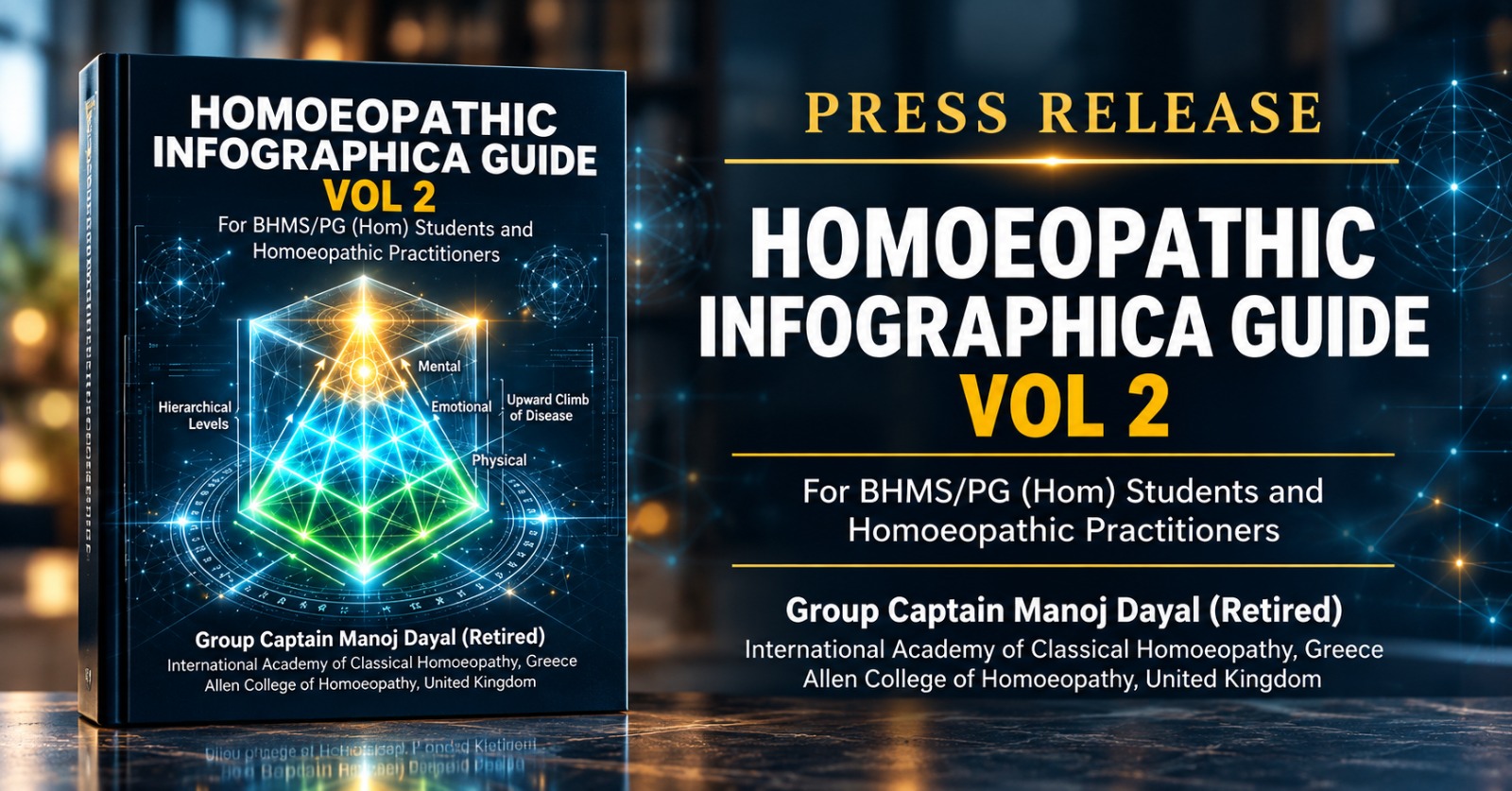
A comprehensive educational guide connecting clinical observation, remedy understanding, and the principles of classical homoeopathy.
India, October 30, 2026: HOMOEOPATHIC INFOGRAPHICA GUIDE VOL 2, authored by Group Captain Manoj Dayal (Retired), presents an educational exploration of classical homoeopathic principles, offering students and practitioners a structured perspective on remedy selection, patient assessment, and the complexities of individualised prescribing.
Designed particularly for BHMS and postgraduate homoeopathy students, as well as practising homoeopaths, the book addresses a recurring challenge within the discipline: the tendency to approach patients through isolated physical symptoms or simplified personality descriptions. The author argues that such methods may overlook the broader characteristics considered important within classical homoeopathic philosophy.
At the centre of the book is an approach that brings together the Elemental Diagnostic Codex and the Clinical Compass, two conceptual frameworks presented as tools for understanding remedy characteristics and interpreting patient presentations. Through this integration, the author seeks to connect theoretical knowledge with the practical challenges encountered during clinical consultations.
The publication places particular emphasis on understanding the individual as a whole rather than concentrating exclusively on individual symptoms. It explores mental, emotional, and physical dimensions as interconnected considerations within the homoeopathic model of patient assessment.
Another important aspect of the work is its engagement with the teachings of influential figures in classical homoeopathy. The author acknowledges the contributions of Samuel Hahnemann and James Tyler Kent, alongside the teachings of Professor George Vithoulkas and Dr. Subrata Kumar Bannerjea. Their philosophical approaches provide context for the book's discussion of remedy understanding, patient development, and miasmatic concepts.
The book also encourages readers to consider how a patient's characteristics and experiences may be interpreted over time. Rather than presenting prescribing as a simple process of matching symptoms with remedies, it advocates a more reflective approach grounded in the discipline's traditional theoretical framework.
For students, the publication offers an opportunity to engage with concepts that may initially appear abstract or difficult to organise. For practitioners, it provides a perspective on evaluating complex presentations while maintaining attention to individual patient circumstances.
The use of an infographic-oriented approach is reflected in the publication's title and educational positioning, suggesting an intention to make complex ideas more accessible and memorable for readers seeking structured study material.
Although the book discusses classical homoeopathic ideas concerning treatment and long-term improvement, these concepts should be understood within their traditional context. Homoeopathic treatments have not been demonstrated through reliable scientific evidence to cure diseases, and the publication should not replace evidence-based medical diagnosis or care.
With HOMOEOPATHIC INFOGRAPHICA GUIDE VOL 2, Group Captain Manoj Dayal (Retired) contributes to the educational discussion surrounding classical homoeopathy, encouraging thoughtful study, careful observation, and a more detailed examination of its philosophical foundations.
About the Author
Group Captain Manoj Dayal (Retired) is the author of HOMOEOPATHIC INFOGRAPHICA GUIDE VOL 2. His work draws upon classical homoeopathic teachings, particularly those associated with Professor George Vithoulkas and Dr. Subrata Kumar Bannerjea, to explore the relationship between theoretical understanding and clinical interpretation.
Media Platform: The Rise Insight
Instagram: @theriseinsight